
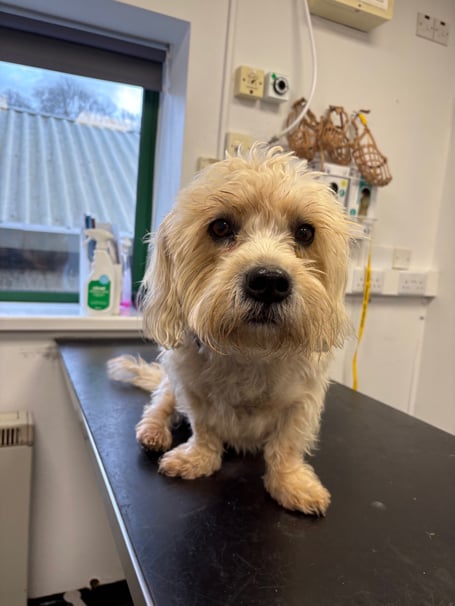
With the excellent countryside we have down in the South West, we are very spoilt with our choice of dog walks from strolls along the coastal path to hiking on the wild terrain of Dartmoor. With this choice, it’s hardly surprising that many dogs love a good run in the undergrowth, exploring the exciting smells and having a good stretch of their legs. But sometimes, in the midst of these adventures, an unfortunate event can occur. This happened to a little pooch called Dougal, where a corneal ulcer, more commonly known as an eye ulcer, occurred.
Dougal is a very sweet 7 year old Dandie Dinmont terrier, which we don’t see too many of here at South Moor Vets. He first presented to me with a sore left eye, due to his favourite activity of sniffing through the bushes. His owners were very quick to bring him in as corneal ulcers are better off being treated as soon as they’re noticed for the best chance of recovery!
A corneal (eye) ulcer is a fairly common but painful condition. It can occur when there is injury or infection to the surface of the eye, often caused if the eye has been scratched or damaged. It can also sometimes occur when there is an underlying eye condition such as entropion (where the eyelids turn inwards and the eyelashes rub against the surface of the eye) or due to a breed disposition, in breeds such as pugs and boxers. This is because brachycephalic breeds, due to the shape of their skulls, have slightly shallower eye sockets, meaning their eyes protrude more.
There are several signs to look out for in a dog that may have a corneal ulcer. These include:


· Squinting
· Excessive blinking
· Redness or a bloodshot eye
· Discharge from the eye.
· In some cases dogs may also paw at the eye too.
A test we can do to check for ulcers involves using a dye called fluorescein. This highlights a corneal ulcer by sticking to the exposed stroma (middle layer of the cornea) and turning it green. It doesn’t stick to the epithelium (outer layer of the cornea). Once this is identified, the first line of treatment normally involves some antibiotic eye drops, pain relief and corneal repair gel to help support the healing of the cornea.
In Dougal’s case, his owner was very diligent at bringing him in for his appointments and giving him his eye drops at home. This combination meant that Dougal was soon on the way to making a speedy recovery and able to carry on with his adventures through the undergrowth!
Comments
We've recently changed our login process. If you have an account for commenting, you will need to re-register on the login window.
This article has no comments yet. Be the first to leave a comment.