
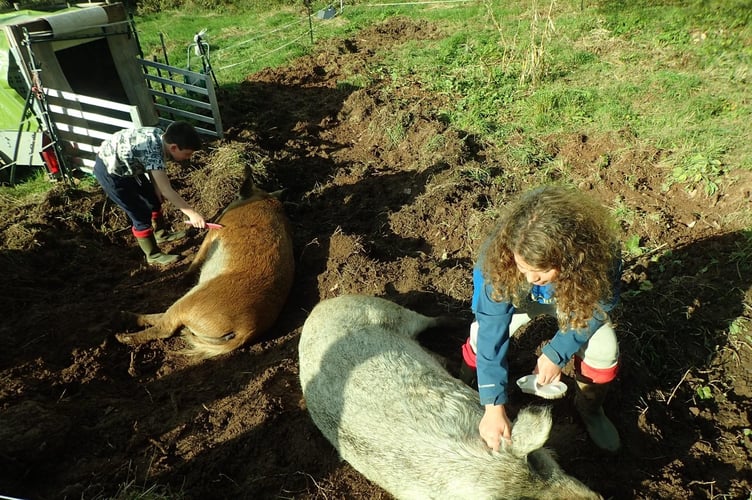
It’s quite early, around 7.30am on a slightly damp winter’s day, and as I walk up to the trailer where Foxy and Hughie are sleeping I hear some very gentle snoring noises. Once I’ve opened the bin containing their food the noises get louder, then out pop these characterful Tamworth-Mangalitza cross pigs from their sleeping quarters. They can go from slightly sleepy to total concentration in nano seconds when food is on offer. The dried supplementary food, which they have every morning, is carefully measured out and divided between the two. They happily munch away for many minutes enjoying individual pellets and savouring the flavours. The robin also makes an appearance, always the first bird to follow the pigs (the non-human gardeners) as they provide free food snacks throughout the day. The thrush also starts to sing in the willow tree above us, welcoming the daylight and the clocking-on time for these working pigs.
Foxy and Hughie are 2-year-old siblings and belong to Desley White of Pigs in Clover (aka Cows in Clover). We will provide a temporary home for them for several weeks as part of our rewilding project at Dittiscombe Estate near Slapton.
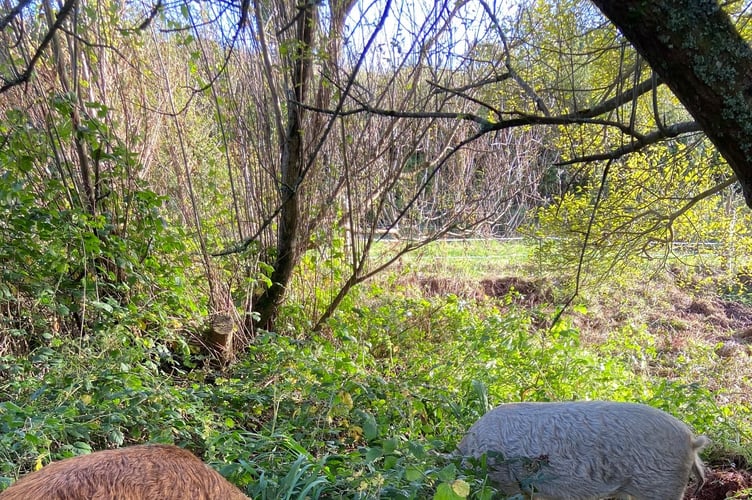
The area they will be working in is semi wet woodland edged by thorny scrub with a spring-fed stream, silt traps and an overflow ditch. It already has willows, hazel, gorse, and 30-year-old apple trees on the surrounding slopes. However, the vegetation is quite dense so Foxy and Hughie will mimic the behaviour of wild boar, the ancestors of domestic pigs, and rootle through the undergrowth. This disturbs plants, roots and soil, creating that edgeland habitat so useful for new species to get a hold. Their droppings also spread mycorrhizal fungal spores, which in turn help trees to thrive.
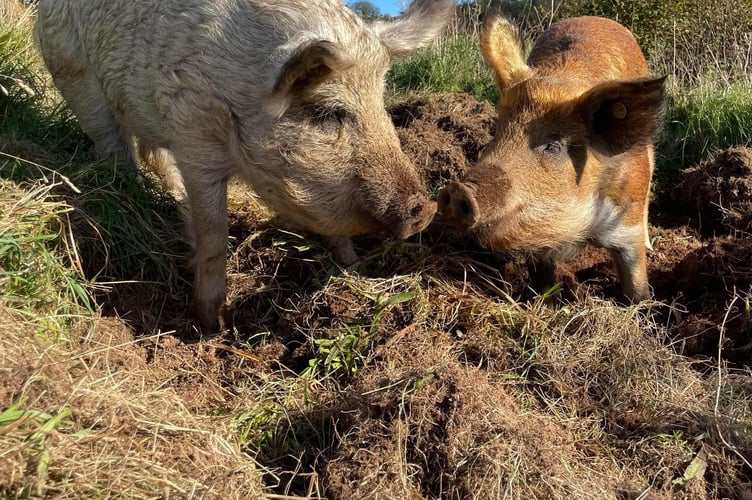
As they move through the area they will chew up and damage bramble roots and other dominant plants, knocking them back and at the same time making holes and hollows. All this could be described as a soft engineering approach by creating structural diversity of the land. As they move through the area they look for tubers, roots, grubs and nuts to eat, in turn creating bare earth patches to provide
space and light for a wider variety of plants to germinate. More flowering plants will provide nectar for bees and other pollinators, and new temporary mini wetland pools will attract other species too.
All this would be hard work for humans, but for pigs this is just what they do naturally. We’ve nick-named them the dynamic duo as between them they weigh around 200 kilos. They have powerful snouts, thick short legs and are specialists at rotavating the soil. Cold, wet weather really doesn’t bother them, but they are also partial to a bit of relaxation and love to sunbathe. They also like to be scratched behind their ears and their wiry coats brushed. They are very clean around their sleeping and feeding areas.
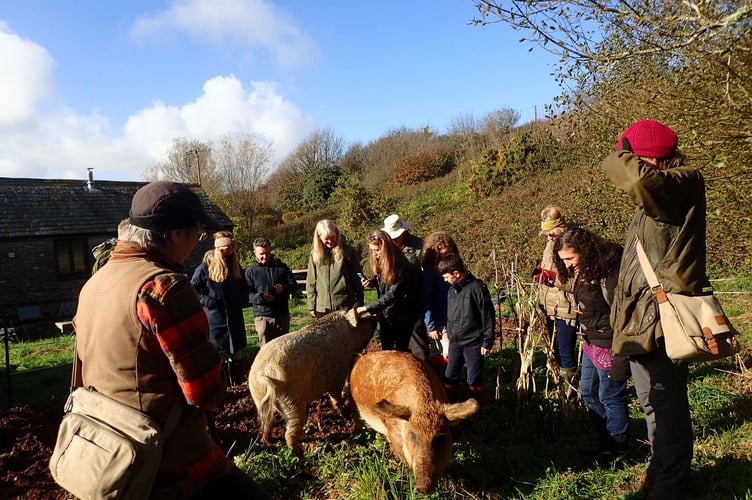
We so enjoy watching their natural behaviour. These two are well socialised and have met many visitors to Dittiscombe. Watching the connection between humans and pigs is quite remarkable; once people spend time with them, observing them in their natural environment, it is an experience never forgotten.
Through Foxy and Hughie we are learning so much about the world of pigs, and how intelligent and knowing they are. They have a much greater vocabulary than the standard ‘oink’. Apparently more than 20 vocalisations have been identified, each one conveying a different message. We have heard their soft gentle murmuring sounds and calling and warning sounds too. They have a pinpoint sense of smell, they yawn, scratch on the apple tree trunks, use their trotters to hold down long roots, and can run at quite a colossal rate – we would not want to try and out run Hughie through thick mud.
This interesting natural behaviour of pigs is not something we can normally observe. In the UK millions of pigs are intensively reared on mega farms and have no access to the outdoors and little space to move around in, especially nursing sows. If you eat pork it might be an idea to try and buy or ask for organic or free-range pork. Happily, there are some local farmers already producing free range and organic pork in the South Hams.
After Foxy and Hughie have left and warmer weather encourages new growth, it will be interesting to observe, survey and document the appearance of any new
species which we hope will proliferate within this area. We will miss Foxy and Hughie and they will leave a big hole, quite literally, in our hearts.
Ruth Saunders is curator of the rewilding project at Dittiscombe Estate & Cottages and is a member of the Devon Rewilding Network.
Comments
This article has no comments yet. Be the first to leave a comment.