
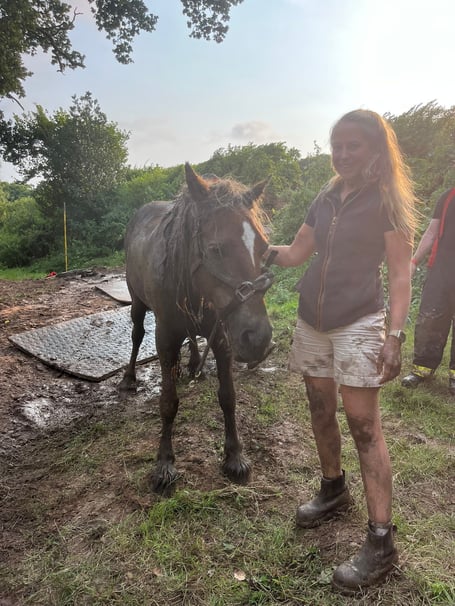
Saturday on call as an equine vet for South Moor often brings surprises, but even by my standards, this one was memorable. The on-call phone rang with a panicked request for urgent help: a horse stuck in a muck heap. I reassured myself. Muck heaps are usually dry, squishy mountains of bedding and, well, what horses produce. Messy, yes. Dangerous, rarely. I set off picturing a bit of digging, a bit of pulling, and a grateful pony.
How wrong I was.
This “muck heap” turned out to be less mountain and more swamp. In fact, it was essentially a slurry bog. Right at the back of it was a pony with only its head sticking out. If the water level rose at all, the situation could have turned from dramatic to tragic very quickly.
A local farmer was already on the scene with a digger, attempting to excavate from the back of the pool to drain it. Accessing the pony from the front meant crossing the bog itself, an impossible option unless you fancied becoming part of the rescue. I clambered up the bank to assess the situation and realised there was no solid ground to get 400kg of soggy pony onto.


I asked whether the fire brigade had been called. They had not. The farmer was confident his digger would do the trick. My concern, however, was that any sudden movement of slurry could cause the pony’s unsecured head to disappear beneath the surface.
As a 5ft 4 female vet in her twenties, telling a man with a plan to stop is not always straightforward. But big girl pants were firmly pulled on. I insisted he stop while I called for back-up. After a brief exchange of “I’m right” versus “No, I’m right”, I explained the risk of the pony’s head vanishing altogether. To his credit and visible dismay, he listened.
By now, the event had attracted an audience. Nothing quite sharpens decision-making like knowing you’re knee-deep in slurry with a crowd looking on.
With more hands available, we improvised. After a farm-wide scavenger hunt, we assembled a rescue kit: strops, stable mats, and a quad bike. Securing the strops meant fully submerging our arms into deep, thick, cold slurry and feeling around beneath the pony. At this point, it felt less like veterinary medicine and more like a bush-tucker trial, minus the cameras, the prize money, and any chance of a quick shower.
Once the straps were in place, the quad bike was used to apply a steady pulling force, inch by inch, dragging the pony onto carefully positioned stable mats at the edge of the pool.
Success, almost.
With the pony half out, we hit our problem. If she stood up, there was a risk she would bolt straight back into the bog or topple down the steep bank. Now that the head and front end were free, I administered a small amount of sedative to keep the patient calm. We then laid additional stable mats to create a makeshift slide and carefully eased the 400kg pony down to solid ground.
In veterinary work, especially in the field, things rarely go exactly to plan. But we adapt, improvise, and always put our patients first. The pony is doing very well and has had no further bog-related adventures.
As for me? I will never underestimate the ability of horses to surprise me, nor how wonderful a hot shower is when you’re head-to-toe in slurry.
Comments
This article has no comments yet. Be the first to leave a comment.