
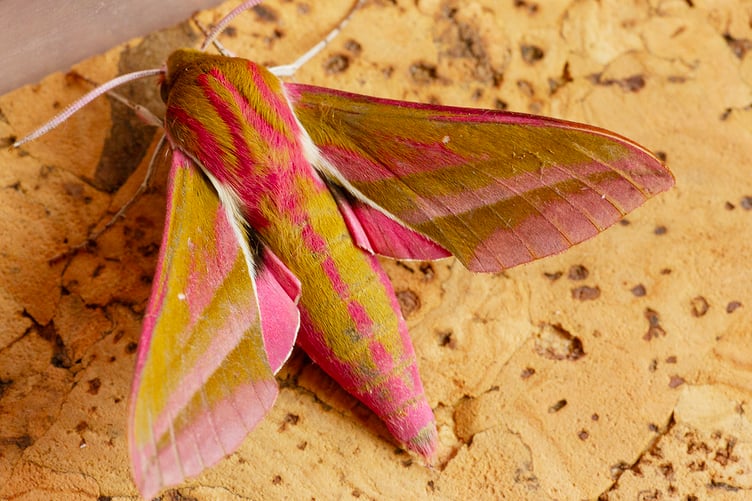
Recently, while taking a shower, I realised I wasn’t alone. Something was flying around me. I eventually caught a rather soggy Elephant Hawkmoth with my hands and managed to open a window to release it. Should I have offered it a towel?
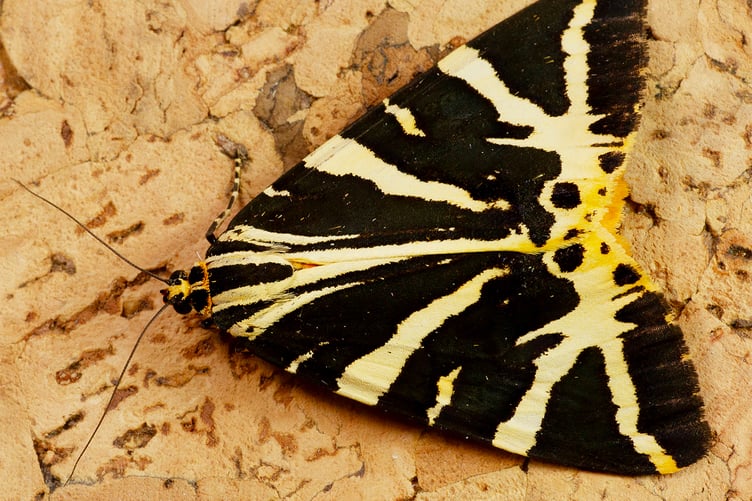
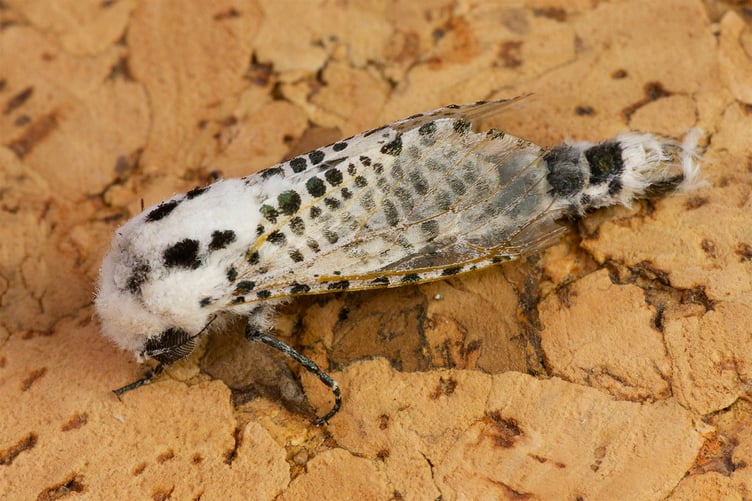
It probably sneaked into my house the previous night, possibly on my clothes, when I was using a moth trap. Two hours produced 60 moths from 38 species. As well as finding an elephant in my shower, I caught 2 Tigers and a Leopard in my trap. That may sound like strange names for moths but there are many other peculiar names for various animals and plants.
The Elephant Hawkmoth gets that name from their caterpillars which slightly resemble an elephant’s trunk.
A few day’s later, after working in my garden, I came inside to find a Poplar Hawkmoth caterpillar was crawling up my trousers.
There is a frequently asked question concerning animal or plant names, ‘Why use complicated Latin names when there are perfectly acceptable English alternatives’.
The answer is somewhat confusing and although many scientific names have a Latin origin, other traditional languages can be used. So it may make more sense to consider them as being international names. Some English names would not be acceptable in other countries.
Most scientific names were created and agreed a long time ago by scientists who were experts in their particular subjects. However, there are occasions when I wonder if some names were created by groups of 18th century naturalists meeting at their favourite inn and having a competition to invent the most unpronounceable name.
In the best examples, species have both common and scientific names which mean the same thing and give a good description of a particular animal or plant. Other names can appear rather bizarre, but it must be remembered that a species name must be unique while also relating to a general family group.
Common names could vary among locations with nearby villages using different names for the same creature.


In a few cases there have recently been efforts to create more logical names but this has caused some temporary confusion between old and new names with records having to include dates or details to ensure clarity of identification.
Forest Bugs are widespread, not just found in forests so they have been renamed Red-legged Shieldbugs which is a better match with the scientific name of Pentatoma rufipes
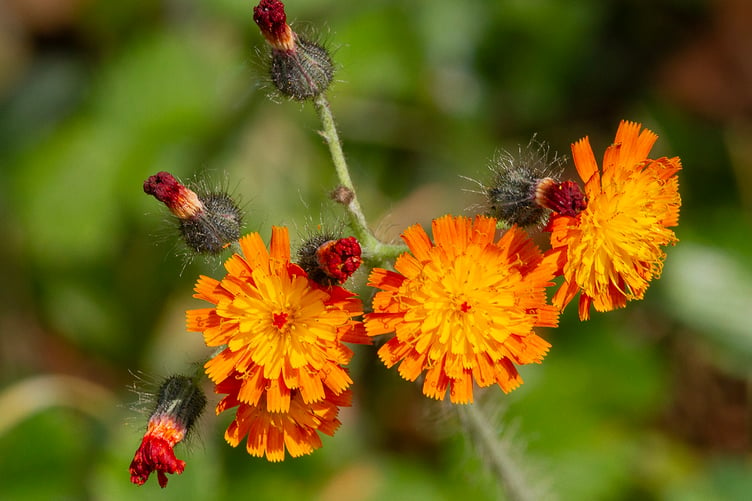
One common plant is known as both Cuckooflower and Lady’s Smock (Cardamine pratensis) with variations between white and pink flowers causing more identification confusion. Another unrealistically named plant is Fox & Cubs. It takes a lot of imagination to explain that name but I suppose the flowers have a slightly fox fur colour and with a lot of exaggeration the faded flower remains could then be considered as the cubs.
A Peacock could be either a butterfly or a bird.
Jew’s Ear fungus was a poor description besides being a racist name so the change to Jelly Ear was long overdue.
The variation in locally used common names reminds me of a tale recorded by Rev Baring-Gould, a Victorian Dartmoor vicar who, in one of his books, wrote about a School Inspector visiting a small and isolated Dartmoor school.
The pupils were upset by this figure of authority and ‘played up’ by deliberately giving incorrect answers. Eventually, through a window, he saw a cockerel strutting across a nearby field and in desperation he asked a pupil ‘What is that bird called’. ‘She’s a stag, sir’ was the boy’s reply. Whereupon the inspector gave a disheartened grunt and wrote in his report ‘The schoolmaster tries his best but many of the pupils are total imbeciles’
However, in a way, the lad was correct because, in the local dialect, cockerels were known as stags and gender was reversed when applied to animals.
So perhaps the current use of both scientific and common names does make a lot of sense.
Comments
We've recently changed our login process. If you have an account for commenting, you will need to re-register on the login window.
This article has no comments yet. Be the first to leave a comment.