
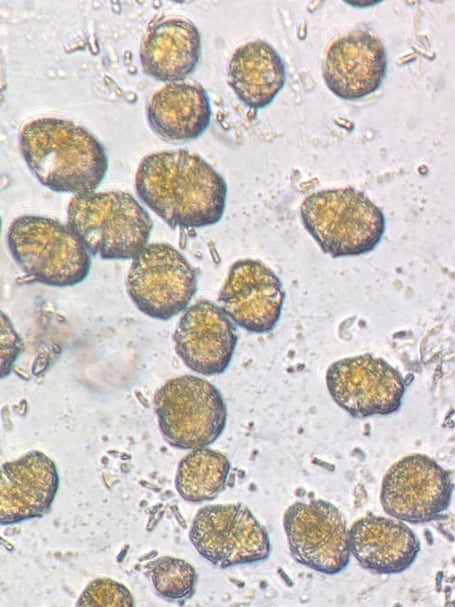
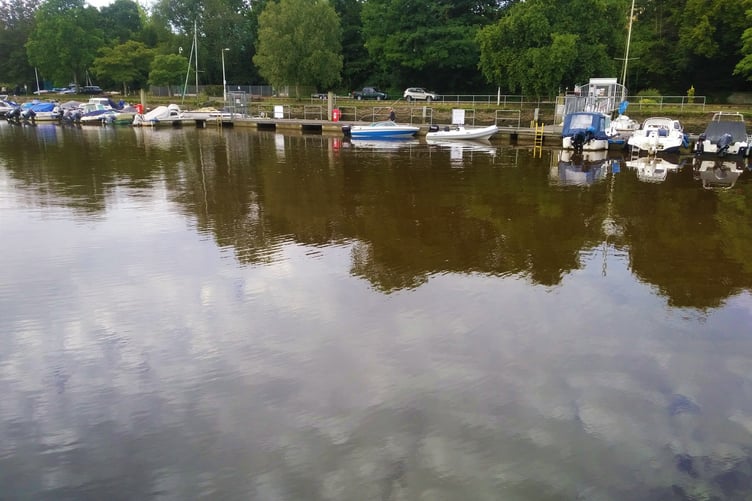
This week I’m writing about organisms so small that you need a good microscope to see them individually — yet, if you visit many of the Kingsbridge creeks at high tide just now, you can hardly miss them. The odd chocolatey red-brown colour of the water, almost like a scene from Charlie and the Chocolate Factory, is the result of a dense bloom of countless single-celled organisms known as dinoflagellates. The bloom itself is often called a “red tide”.
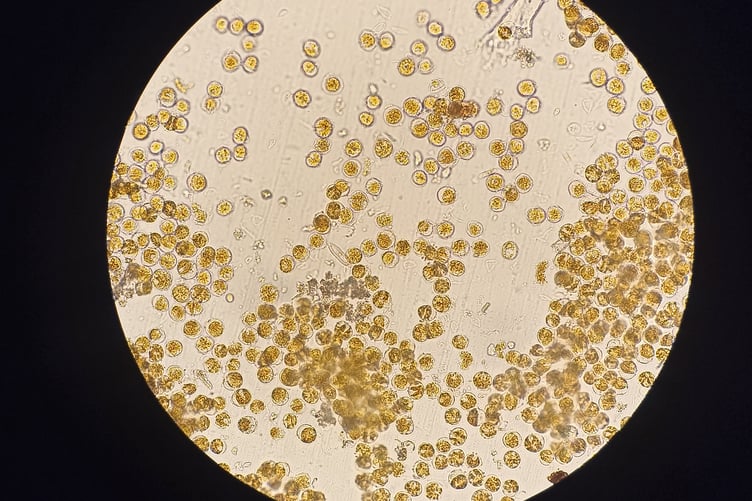
We have become unfortunately over-familiar with our streams, rivers and estuaries being discoloured by runoff from roads, parks, gardens and farmland after heavy rain — but there has been no real rain for weeks. This bloom is instead the result of warming waters, sunny weather, elevated nutrient levels and an organism ready and waiting to reproduce exponentially through simple cell division.
They are quite bizarre organisms, sharing some similarities with plants — they can photosynthesise their own food using energy from sunlight — with animals, as some eat smaller organisms, and even, apparently, with fungi, as some absorb organic matter from their surroundings. As suggested, they are tiny single-celled organisms, and all have, at some stage, two whip-like ‘tails’, (called flagella) that beat to propel them through the water, often giving the impression that they are spinning. They do have some coordination, though, because they are able to swim away from the top-most layer of water, where they may be harmed by the ultraviolet of sunshine. I have paddled over red tide waters where the top few centimetres of water are crystal clear, with a dense cloud of dinoflagellates below.
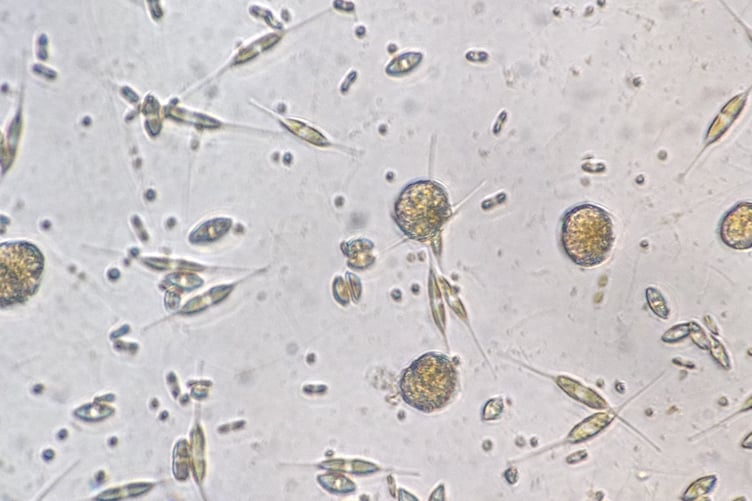
We have seen streaks of these blooms along the Yealm Estuary, but locally they are now almost an annual phenomenon of the Salcombe-Kingsbridge Estuary (or Kingsbridge-Salcombe, if you’d rather). I have no reason to believe they are absent from our other estuaries, but they are never present in such numbers that they discolour the water and become so obvious — unless you know different? We are certain that the critical factor within the Kingsbridge creeks is the level of nutrients that can continue to support such blooms, but why mostly the Kingsbridge creeks?
There may be some reasons why more nutrients enter the estuary here, and we do need to reduce those nutrients every which way we can. Increasingly, though, we think the nutrient situation is exacerbated by the same unusual geography and hydrology that make this estuary so special for its marine communities. The rain catchment area is relatively small, the estuary retains a large volume of water even on the lowest tides, and there are no rivers to help flush nutrients out. Altogether, this means that nutrients and warm water largely move up and down with the tides rather than being washed away. If you take a boat downstream through a red tide, you will often see a very sudden and stark end to the discoloured waters, with almost crystal-clear coastal waters below.
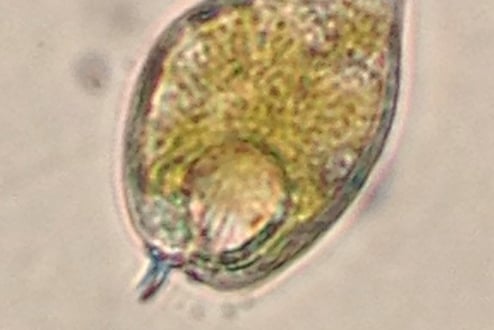
So is there a problem? On one level, the dinoflagellates are taking up a lot of carbon as carbon dioxide through photosynthesis, helping to feed the estuarine and coastal food chain, with some of that carbon beneficially becoming trapped in the seabed sediments. But there are environmental and human concerns too.
Some dinoflagellates can produce seriously nasty toxins, although locally, at least, these blooms do not seem to affect us directly beyond their rather unlovely appearance. We must always allow for the possibility that some people may have an unusual allergy to dinoflagellates, but most of us seem unharmed by contact with, or even swimming through, a bloom. However, because clams filter-feed on



dinoflagellates, there is a danger that they may bioaccumulate any toxins, and eating them could make you very ill. Commercial shellfish producers depurate clams in cleansed seawater to reduce the risk from contamination, although this process is not effective against every type of algal toxin and shellfish waters may be closed while particular dinoflagellate species are present.
Environmentally, the same toxins could affect some marine life or birds, but we are not seeing this. What must be happening though is that these blooms will be making the waters dark beneath them, shading natural seaweeds and seagrasses from the sunlight. There is also the chance that at night, and as the blooms die and decompose, oxygen levels in the water may be reduced, potentially affecting fish and other marine life. We have to be clear that these blooms have been going on, most years, for some time and we may not realise their full impact unless we can prevent or minimise them.
So how might we stop or at least minimise these blooms? Here there is something that we should all consider and all do. Yes, we have impacted the climate and there are things that we can do there but that’s a bit of a supertanker that’s going to take a longtime to reverse. So we need to focus our efforts on reducing the nutrients that get into our water courses, directly and indirectly: directly from our land, streets and gardens; indirectly from our sinks and drains. It is not always about stopping these inputs completely, but about reducing them to an absolute minimum.
The problem is the accumulation of many many often quite small sources, the answer is the cumulation of many many equally small positive efforts – today, tomorrow and always. Sinks, toilets, road drains and streams are common entry points – a good rule is nothing should down the pipes that you haven’t eaten first!
Comments
This article has no comments yet. Be the first to leave a comment.