
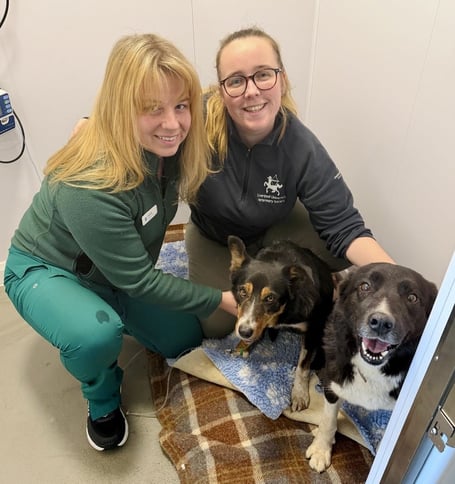
It was a Friday and the last consult of the day at South Moor Vets, when at our Dartington clinic I was presented with a collie, called Nell. Nell had been working with the sheep all day and suddenly started walking with a wide based stance, stumbling and shaking all over. She was reactive to the quietest of sounds and the smallest of movements (this is called hyperaesthesia). Due to the sudden onset in an otherwise healthy dog, we believed she had eaten something toxic. Nell was admitted for further investigations and monitoring overnight.


Within an hour of Nell being admitted, our out of hours team received a call from the farmer: their other collie, Wren, had similar symptoms and was brought straight in. Wren’s symptoms were more advanced: she was struggling to walk and very reactive. The toxin was causing changes in behaviour – aggression, in a dog that had never been aggressive in her life. This made things rather difficult, but we persisted and as soon as we were able, we administered medication to reduce the tremoring and control her seizures. A major concern was her temperature getting too high: it spiked at 41.0 degrees (normal: 38-39.2). Such high temperatures risk multiple organ damage. We therefore had to actively cool her whilst trying to control her neurological signs. At this stage, we had her on a continuous infusion of anaesthetic to control her seizures and tremors.
There was no letting up as once we had managed to stabilise her, we then had to make sure her temperature didn’t get too low. As we monitored, her temperature dropped to 36.3 – again this is out of the normal temperature range and has similar risks. We had to wake her up from anaesthesia and actively warm her. Meanwhile, we had an update from the farmer: the food waste bin had been found knocked over following bin collections and he had a strong suspicion that both dogs had eaten mouldy food.
Thankfully Nell had calmed down and her symptoms improved by the hour. With minimal changes on her blood results, we decided she had only eaten a small amount and did not require fluid therapy. Wren however, now reversed from her anaesthetic, was still tremoring and hyperaesthesic. We decided to give her an infusion of intra lipid. Intra lipid is a treatment we give intravenously to absorb any fat-soluble toxins within the blood. After this had been administered her neurological symptoms started to resolve. By 2.30am, she was finally stabilising. Her temperature was back to normal, her tremoring was reducing and her seizures had stopped. We had a lovely, sweet, non-aggressive collie back!
We kept both dogs in for the rest of the night, with Wren requiring further fluids and pain relief. Nell went home the next morning and Wren was discharged later that day. The rapid response to intra lipid led us to believe the toxicity we were dealing with was a mycotoxin (produced by certain moulds), which fits with the suspiciously (licked) clean food waste bin!
Wren was seen for a blood check one-week later to ensure she didn’t have any lasting organ damage. I am pleased to report that both dogs are doing extremely well and are back in the fields working with the sheep!
Comments
This article has no comments yet. Be the first to leave a comment.