
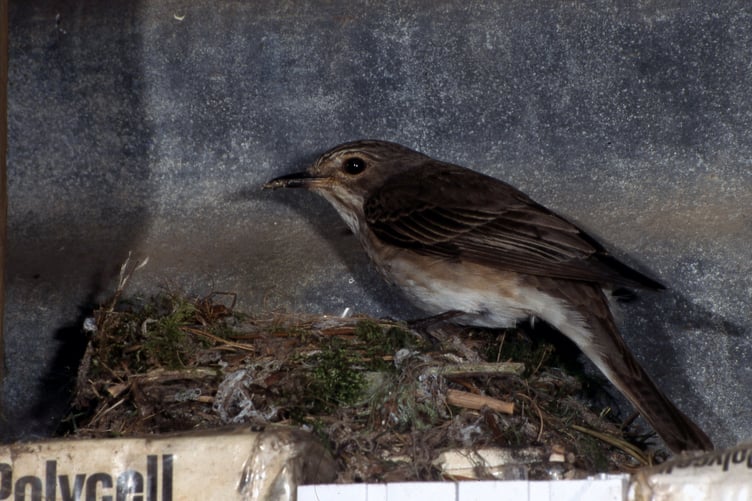
In Britain the Spotted Flycatcher has declined by 92% since the end of the 1960s. It used to be seen in every village in the country, especially in vicarage gardens. It perches on a favourite branch or post and waits for insects to pass by. Then it takes off on a fluttering flight, snapping up insects on the way and finally returns to its perch. They are migrants, arriving here in May and wintering in tropical and southern Africa. They are on the British Red List for the birds of greatest concern, as they continue to fall in numbers year by year.
In 2000 Rod Bone decided to do a special survey of his parish, Aveton Gifford, recording all the breeding birds in the parish.
At the end of the year he sent the survey, with all the other records he always sent to the Devon Birds recorder for the annual report. His records for Spotted Flycatcher caused a stir not only in Devon but also at the RSPB. Rod had found 38 pairs of Spotted Flycatchers nesting in Aveton Gifford parish.
That was a far higher number than anyone, except Rod, would have expected. Rod worked with a team from the RSPB for the next few years, recording and ringing the birds to find out why Aveton Gifford should be such a special parish.
The answer was partly its habitat, including the River Avon and the way it was farmed but probably the main reason was that Rod Bone was a very special naturalist, who spent hours watching and waiting. And he loved his home patch passionately.
He saw much more than most of us would have seen. Even in Aveton Gifford the decline has continued; in 2002 Rod found only 31 pairs of flycatchers.
Rod’s diaries, from the 1960s until 2023, are now safely kept at the Cookworthy Museum in Kingsbridge and you can ask to look at them there. You can see the amazing 2000 survey, together with a photo of Rod and a summary of his remarkable naturalist’s life.
Meanwhile back at Cotmore in 2001, Bryan, Chris and I were having our Garden Odyssey in Frances and Wolfgang’s garden. Wolfgang had seen a pair of Spotted Flycatchers around his big, open shed at the top of the garden, not fat from the geese and the Robins’ nest.
We soon found the empty nest, perched on a shelf in the shed, next to a half-empty packet of Polyfilla! On 23rd May we found an egg in the nest, on 24th there were two and on 25th three eggs. By 4th June Chris and Bryan had moved two hides into position, one inside the shed and one outside.
They thought we might photograph them coming in And out of the shed.

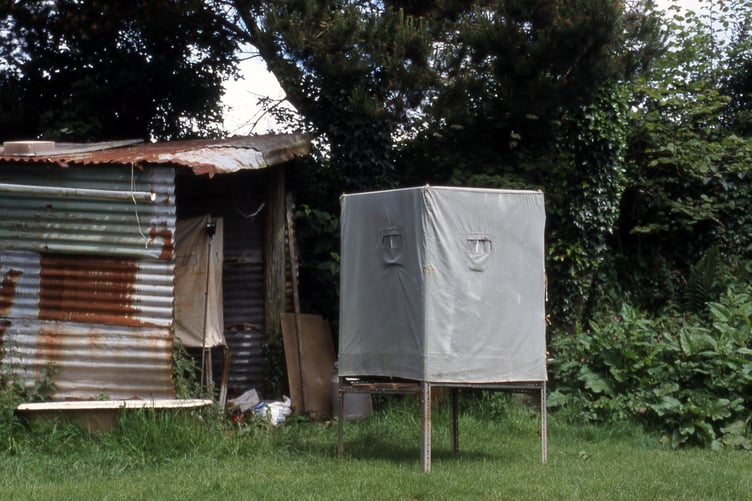
We would often see Bonny, the family cat, walking slowly across the grass from the house, or stretched out on the warm paving stones, basking blissfully in the sun. Bonny was no threat to our birds, she was seventeen years old and very arthritic, enjoying life at a slow pace.
We all took turns at watching the nest and fell in love with these birds. We thought that the bird sitting on the nest was the female. One day Chris brought his son Pete to see the birds and share the magical experience of watching them from the hide, only a few yards away. The hen bird would occasionally look up and a few moments later the male would arrive and give her a morsel to eat. Our first hint that he was on his way was to see her head lift in expectation. The next moment we would see his flying shadow on the corrugated iron wall of the shed and he was there, perched on the edge of the nest, reaching down to feed her. There seemed a strong bond between the birds.
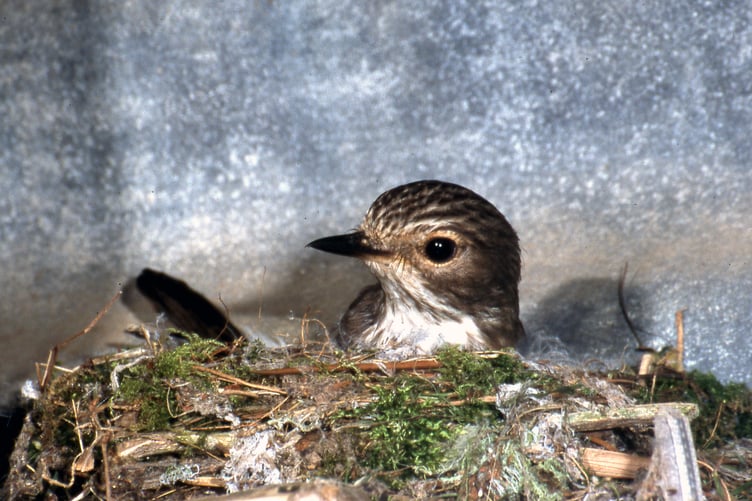
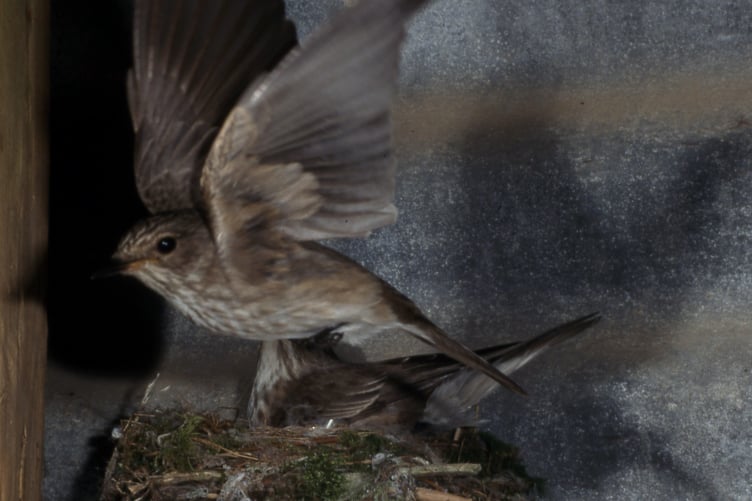
On 12th June we saw one of the parents coming in to the empty nest with a small moth and reaching down with it into the nest. The eggs must have hatched. We were looking forward to watching the young grow and see the family fledge, ready to take the journey south to their wintering quarters in Africa. The most bitter disappointment of our Garden Odyssey came on the morning of 14th June, when Bryan arrived early in the morning to see this note, left by Wolfgang at the nest:
“I fear that a black cat with white markings had the flycatchers. I saw it between the barns in the evening. Since then no sign of the adult birds!?”
Comments
We've recently changed our login process. If you have an account for commenting, you will need to re-register on the login window.
This article has no comments yet. Be the first to leave a comment.