
Spaniels are one of my favourite breeds of dog and we’re lucky to see a large number of very healthy active spaniels at South Moor Vets.
They are usually very enthusiastic, friendly patients who always want to know what’s happening next! From an orthopaedic surgeon’s perspective, they are a breed we see more frequently than others due to a condition called Humeral Intracondylar Fissure (HIF).
HIF is a crack that develops in the humerus bone at the elbow joint; Spaniels are predisposed. This increases the risk of an elbow fracture in affected dogs. Some dogs may show no symptoms until the bone fractures and some may show intermittent lameness.
Unfortunately for Finn, he was in the former category until one day in May, whilst playing in the garden he suddenly went hopping lame on his right front leg.
It is common for an elbow fracture to happen without a high degree of force in HIF affected dogs so when his owners brought Finn in to us clearly very uncomfortable, we were immediately concerned.
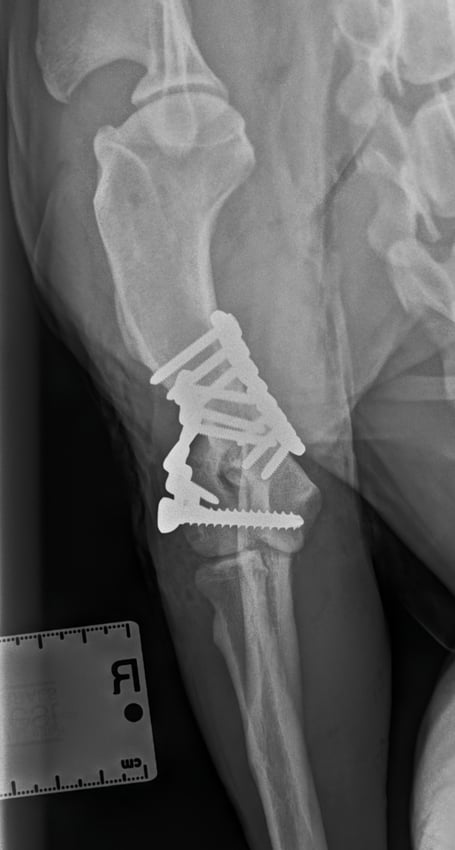
Finn was examined, given pain relief and xrays were taken. These revealed a ‘Y’ fracture of the humerus at the elbow joint. A complex fracture where the bone is split into three pieces, these are one of the more challenging fractures to repair as it is essential to accurately realign the bones so that the elbow joint remains functional.
The next day, we repaired Finn’s broken elbow using two bone plates and a large screw across the bone to fix everything back together. We are fortunate at South Moor Vets to have the experience, facilities and expertise to operate on these sorts of complex orthopaedic cases. Finn recovered well and with lots of rest and TLC his bone healed.
However, our attention then turned to Finn’s other elbow. As I mentioned, HIF can sometimes show no symptoms and both elbows are often affected.
The crack in the humerus bone is very narrow and often impossible to see on xray. A CT scan is the best way to diagnose HIF. Finn came in for xrays to check his broken bone had healed six weeks after the accident, so his owners sensibly chose this opportunity to CT his left leg at the same time: unfortunately, a HIF was found here as well.
If a HIF is found and the dog is concurrently lame, we recommend stabilization with a screw to stop the pain and prevent the HIF from fracturing. If there is no lameness, research has shown that there is a 1 in 5 chance of the crack progressing to a fracture. If the bone is stabilized with a screw to strengthen the bone, there is a very low chance of fracture and the surgery and recovery time are shorter.



Placement of the screw is through a very small area in the humerus bone and we frequently use a 3D printed guide, created from the patient’s CT scan to help get perfect screw placement.
Finn had a screw placed in his left elbow in July and after another rest period he has finally completed his “HIF journey” and is back to running around in the garden and busy asking what happens next!
Comments
We've recently changed our login process. If you have an account for commenting, you will need to re-register on the login window.
This article has no comments yet. Be the first to leave a comment.