
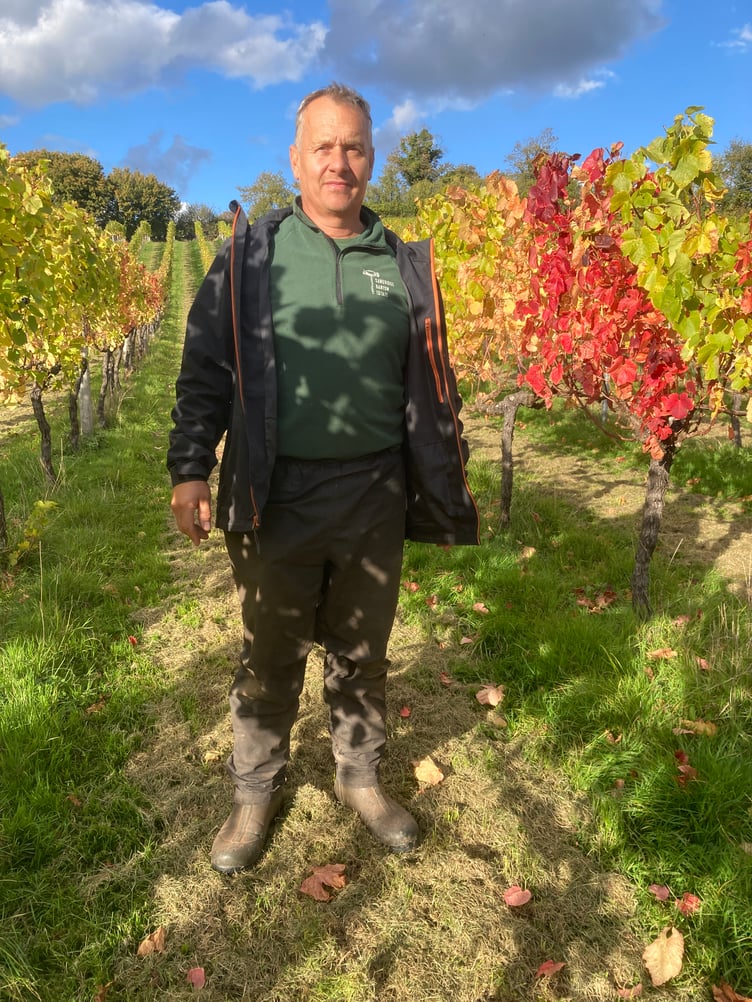
Sandridge Barton Wines at Stoke Gabriel has just had it’s best harvest ever in terms of quality and one of the best in terms of quantity.
The company has been growing grapes and making wines since 1981.
They have around 14.5 hectares (37 acres) of vines on the estate leading down to the River Dart with six varieties including Pinot Noir, Pinot Gris and Chardonnay along with lesser-known Madeleine Angevine and Bacchus.
The winemakers produce red, white and rose along with sparkling wine.
Vineyard Manager Alex Davidson said: “This year has been fantastic for for quality; it's probably our second second best yield but the quality was just exceptional so that means you don't have to fuss around with the wine so much because the quality is already there - you don't have to add certain things to kill off disease and it's just set up perfectly.”
The heatwave replicated conditions in the south of France and global warming means that French wine houses have been buying estates in the south of England.
Alex continued: “We finished our last picking with a community pick on October 3 with our Chardonnay, which was the earliest ever. Sometimes we picked our Chardonnay in November.
“The community pick was a great event with about 50 people coming along who bought tickets which sold out in 20 minutes.
“They did two hours picking whilst being supplied with tea and coffee and finished of with a glass of wine and a barbecue. We stage many events throughout the year.”
The next major event in the calendar is the release of ‘Madeleine Angevine’ which, although white, is the estate’s equivalent of Beaujolais Nouveau, with only a few thousand bottles are made.




The team are now waiting for the leaves to fall off and the vines go dormant.
Pruning resumes in mid-November, with around five or six working and that can take three to four months.
In the spring the weather warms, the buds come out and there is then an air frost threat towards the end of April.
Alex says you then need a “good warm summer” to keep the vines disease-free.
“The buds will grow and then within the first 12 inches of each shoot you'll usually have two bunches of grapes that will form ,” he said. “From there, we have to spray the vines with Foliar feeds to bolster them up.”
The whites and roses are usually drunk within two and three years with the reds still going well for a decade or more.
The English climate has traditionally been best suited for white and sparkling wines but, due to global warming, reds are improving all the time.
Some say the best wine is produced from the poorest soil and at Sandridge Barton the soil is loamy with lots of limestone.
One of the fields is called ‘Stony Field’ because it is stony with a big limestone ridge running through it and large lumps of limestone.
There are two other vineyards in the South Hams, the Calancombe Estate near Modbury and the Bantham Estate
Visit: https://sandridgebarton.com/
Comments
We've recently changed our login process. If you have an account for commenting, you will need to re-register on the login window.
This article has no comments yet. Be the first to leave a comment.