
A meeting point for lovers of knick-knacks, curios or historical memorabilia, a throw back to a gentler time when social media’s intrusive reach was notably absent.
Maybe it’s the joy of browsing for the sheer hell of it without feeling the pressure of the hard sell. Whatever the reason, street markets hold a special place in the hearts of local communities.
What’s more, the demand for markets specialising in hand-made arts and crafts is on the rise.
According to a 2020 report by The Crafts Council, craft sales rose from £883m in 2006 to more than £3bn in 2019, showing that “there is a growing new generation of younger craft consumers”.



Thought arts and crafts were just for old codgers? Think again.
Across the UK, the number of people buying craft has now reached 37.7m, with a four-fold increase in the volume of craft objects bought annually between 2006 and 2020, from 5.6m to 24.7m.
And if hand-made jewellery, environmentally-friendly soaps and shampoos, woven dolls or wooden ornaments created from reclaimed timber are your thing, there’s a good chance you’ll find what you’re looking for at the Art, Crafts and Collectables Market in Kingsbridge.
The market has been a feature of the town for more than 30 years, and the Market Hall building in Fore Street, which dates from 1911, has been at the centre of that.
For Kerry, the market’s organiser, it represents a whole lot more. “They are beautiful items sold by beautiful people. They are locally sourced and created; it creates community and gives a focus to local people.”
She’s quick to dispel the view that local markets invariably sell little more than bric-a-brac. “There are lots of talented and creative people in Kingsbridge whose items need to be showcased,” she points out with genuine passion.
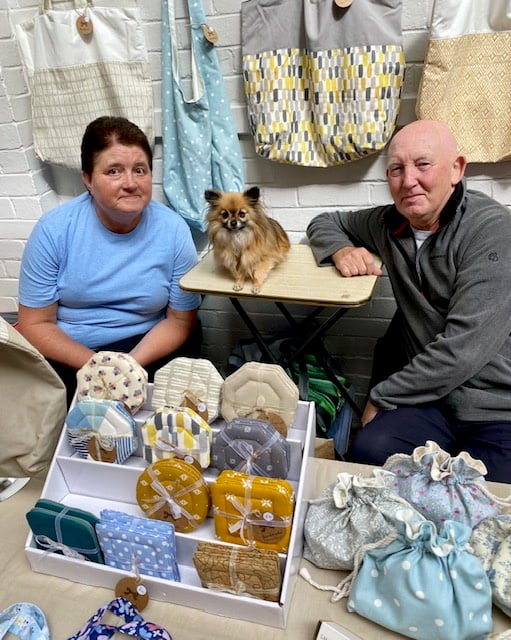
At one of the stalls I find Mike and Julie Newman, who moved from Birmingham to the South West four years ago (“it was nice to move out of the city – we couldn’t be happier,” says softly-spoken Mike in an unmistakable Brummie accent).
Mike likes painting and sketching, and today he is selling a set of delicate watercolours depicting local scenes. Wife Julie’s specialty is weaving colourful bags. The star attraction, though, is their daughter’s little Pomeranian dog, who calmly surveys potential buyers with approving eyes.
There’s Cynthia Baker’s charmingly bespoke ‘Heirloom Henries’, which take 15 hours to make, and her dainty Wind in the Willows characters. Sitting close by in the next stall is Julie Worms with a display of hand-made jewellery and resin bowls.
Having fled the hustle and bustle of a big city – in this case London – for the quieter charms of Devon, Julie moved to Diptford about five years ago, and set up her stall after being “headhunted” by Kerry. “I like the ambience here, there’s a family feel and nowhere near the pressure I had in London.”
The ear studs she sells have proved popular with everyone, recalling that her last client was a 92-year-old woman. But her clientele is also made up of much younger ‘uns.
“People in London prefer thick, chunky jewellery, but school kids here are more sensible. They have more refined tastes,” she adds with a wink.
Louise Moore’s an expert wood carver, her wares ranging from ingenuous boot pulls (a new one for this hack), bird-feeders and dog bowls, to petite door stops, all fashioned out of reclaimed timber. “I use anything that I can get out of a skip – after obtaining permission, of course – including disused pallet wood and bed frames. People are getting into recycling these days,” she says with a beaming smile.
Her enthusiasm and devotion to her craft is infectious and all the more poignant when she reveals that she works as a delivery driver during the day. “I’ve been getting up at 4am every morning for the last 17 years,” she says, still smiling.
I mention local MP Mel Stride’s recent comments about the over 50s trying their hand at being delivery drivers. “Lugging 25 kilos up a flight of stairs can be hard work,” she ponders thoughtfully.
Her sister, Tina Mears, has a stall right next to her, and has been a regular at the Kingsbridge market for the last seven years, making and selling a natural range of soaps and shampoos. Why the attraction? “My daughter has eczema and I have family members who suffer from psoriasis. I avoid chemicals and go back to basics, which is what we should all be doing, anyway.”
The concept may sound simple but the manufacturing process is infinitely more complex. To develop her range of shampoos, Tina went through 15 different recipes before finding one she liked. Not so much a case of trial and error, and more hitting on “a certain chemistry”.
Using her family members as willing guinea pigs also helped, she adds as an afterthought.
The process for making soap is equally painstaking, as it’s made from beeswax.
“It arrives dirty and has to be melted down, which attracts bees. I then put it through a filter system, so it’s quite labour intensive.”
And that’s perhaps why the public is drawn to these products. There’s something reassuring about the knowledge that only a handful of people (at most) went to the trouble of producing something in small batches.
It’s also worth noting that attempting to make a profit seems slightly less important to them than the satisfaction of producing something with a personal story behind it.
As the Craft Council’s report notes: “The growth in the public’s desire for authenticity...for ethical and sustainable consumption have helped fuel an interest in...handmade objects.”
TV has also been quick to adapt to this trend, producing a host of programmes, such as The Great British Sewing Bee and The Great Pottery Throw Down, which have attracted millions of viewers.
Bridget Kirke, a retired antique dealer who works closely with Kerry to bring the market together, is a whirlwind of energy, and unashamedly promotes the market whenever and wherever she can.
“It’s a very social event and it’s one of the most popular markets in town. We have a huge following now. It’s a real community of people,” she says, revealing that she once worked as a PA assistant at The Sun newspaper during its ‘halcyon’ days in the 1980s alongside such notorious characters as Kelvin Mackenzie and Wendy Henry.
I ask her how difficult it is to keep the tradition of Arts and Crafts going, despite their evident popularity.
“It’s not about making a profit. I sell at reasonable prices and that’s probably why we do quite well in here – it’s good value for money.”
Any downsides? “Parking. You can’t park on the pavement anymore. We haven’t asked the council, but it would be nice to have parking spaces so that we can set up and unpack over the road!”
The next Arts and Crafts market at Kingsbridge will be on September 23.
Comments
This article has no comments yet. Be the first to leave a comment.