
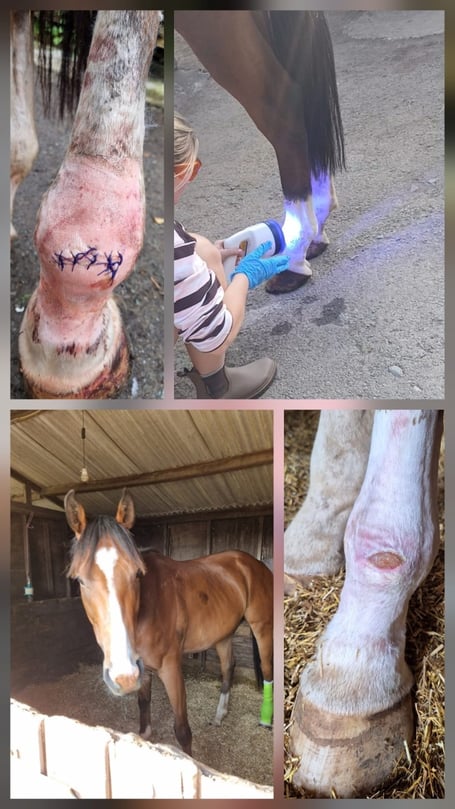
It's never the call you want to receive just before starting a nurse night shift at South Moor Vets: your horse has attempted to jump out of his field and suffered a severe laceration to his hind leg.
Fortunately, one of our fantastic equine vets, Laura, was available to assess Walter that evening. Examination revealed that he had sliced through his extensor tendon. Although any tendon injury is serious, the extensor tendon runs down the front of the leg and carries less weight than the flexor tendon, making the prognosis more favourable.
Laura thoroughly flushed the wound to remove any debris before carefully trimming the damaged tendon tissue and suturing the wound closed. A padded support bandage was then applied, and Walter was placed on strict box rest while the healing process began.
As with many wounds on horses—particularly those over joints and other high-motion areas—the wound initially progressed well. However, after five to six days it began to swell and break down, a common challenge in equine wound management.
Having seen excellent results with Phovia in our small animal dermatology department, I was keen to explore whether the same light therapy could benefit Walter's recovery. Phovia is a non-invasive LED light therapy system that uses a specialised chromophore gel to generate multi-wavelength fluorescent light energy. This penetrates different depths of the skin, helping to reduce inflammation while stimulating tissue repair and cell regeneration.
Walter began weekly Phovia treatments alongside his ongoing wound care. The results were encouraging. Increased blood flow to the area promoted healthy healing, excessive granulation tissue ("proud flesh") was minimised, and by his fourth treatment the reduction in wound size was remarkable.
Perhaps Walter was the easiest patient of all—he seemed to thoroughly enjoy each treatment, standing quietly as though he were at a spa!
Light therapy is becoming increasingly recognised as a valuable addition to wound care because of its ability to support the body’s natural healing processes. For equine patients where wounds are often affected by movement, tension and the risk of excessive granulation tissue, having a treatment that supports controlled and efficient healing can be particularly beneficial.
Just seven weeks after the injury, Walter was able to return to turnout and his dressings were removed. Injuries of this nature often require several months to heal, although recovery times vary depending on the individual case. While meticulous wound management was essential throughout, I believe the addition of Phovia light therapy
played a significant role in accelerating Walter's healing and helping him return to normal life sooner than expected.

Walters case also highlights the importance of seeking veterinary attention quickly when a wound occurs. Early assessment, thorough cleaning and a tailored treatment plan can make a significant difference to the outcome of complex injuries.
If you would like more information on how light therapy can help with your horse or pet please contact the South Moor Vets: Dartington.
Comments
We've recently changed our login process. If you have an account for commenting, you will need to re-register on the login window.
This article has no comments yet. Be the first to leave a comment.