

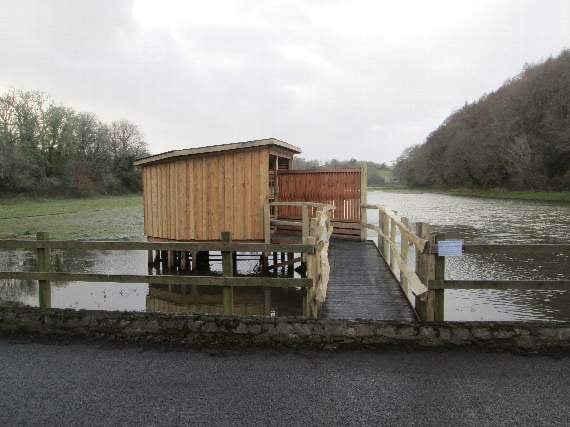
Dartington Hall bosses have said they plan to find a new site for a controversial wooden bird hide that has been ruffling feathers on a beauty spot piece of “Olde England”.
The prominent 20sq m bird hide, which was built without planning permission on Queen’s Marsh on the Dartington Estate, has come under attack amid claims that it was sited on the wrong spot and wrecked popular views.
Even the Historic England public body, which is tasked with the job of looking after the nation’s historic environment, has declared the hide’s situation as being “harmful” to the area.
Now Dartington Hall has revealed it has begun talks to sort out an alternative location for the hide.




Dartington Hall Trust estate development director Martyn Evans said: “We researched and consulted with local people, including birdwatchers, to identify the best functional location, submitting a planning application to South Hams District Council in December 2017.
“This process has given us an opportunity to reflect on the bird hide’s location and consider the views of our initial consultation alongside formal comments received by SHDC as part of that application. Based on these views, and those of Historic England in particular, we’re exploring with SHDC moving the bird hide to a different location on the marsh.”
The hide was designed and built by architect students at Plymouth University late last year following the construction of a new pond at the Totnes end of the former tidal creek.
The major Queen’s Marsh project to increase the area’s biodiversity has involved creating two new ponds and seven shallow seasonal ponds on the old marsh, which was once a tidal creek where Bidwell Brook joins the Dart, but which was lost with the construction of Totnes Weir.
The Dartington Hall Trust planning application for the hide has attracted dozens of public comments, many in support of the hide as well as protests about its location at the head of the marsh, just inside the lower entrance to the estate.
However, Historic England pointed out that the southern end of the Dartington Estate drive has “remained remarkably unspoilt and under-developed, still conveying an impression that one is entering a piece of ‘olde England’.”
The public body continued: “While we have no objection to the principle of a bird hide being erected on Queen’s Marsh, we do consider the chosen location to be a particularly harmful one in relation to the special qualities of the registered park and garden.
“We are not convinced that a less harmful position would not have been feasible, which could still have provided many of the intended benefits of the hide. The application fails to present a full options appraisal for the location of the hide, with convincing explanations for why no other locations were suitable.”
Mr Evans said the construction of the bird hide had been part of an estate project involving undergraduate students at Plymouth University’s department of architecture.
“The project’s aim was to increase the practical and problem-solving skills of students through learning by doing, as well as to offer our visitors greater opportunities to learn about and enjoy our conservation programme,”
he explained.
Comments
This article has no comments yet. Be the first to leave a comment.