

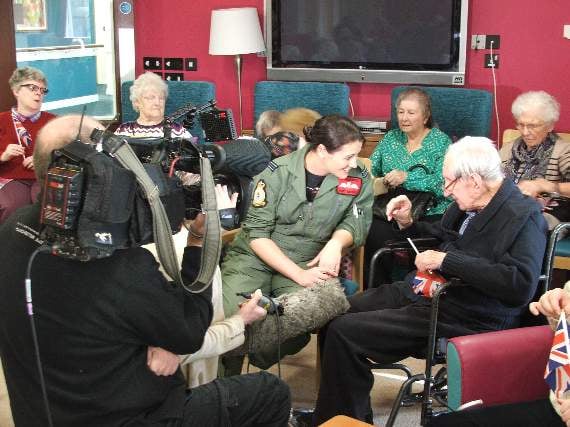
A Second World War RAF officer has celebrated his 103rd birthday and had his wish granted – to meet a present-day woman RAF pilot.
Warrant Officer Frederick Samuel Vinecombe, born in 1914, served with the Bomber Command Air Crew Lancasters, attached to the 419 Squadron Royal Canadian Air Force, until he was shot down over France.
The war hero was captured by the Nazis and served time as a prisoner at Frenes, France; Buchenwald, Germany and Stalag Luft 3, Poland.
While he was a prisoner, he became a member of the KLB club, which included the 168 allied airmen who were held prisoner at Buchenwald concentration camp.



While celebrating his 103rd birthday back in December, Fred was talking to a fellow resident at The Rise, a retirement and care home in George Lane, Plympton, and he couldn’t believe the RAF now had women pilots.
He was eager to meet one, so family friend Wendy Sheppard got in contact with Flt Lt Kerry Bennett who has family living in Plympton.
She has served in the RAF for 13 years as a pilot with 101 Squadron and was currently flying Voyager aircraft. Last year, she appeared in the BBC programme Astronaut.
Kerry was delighted to accept the invitation to meet Fred – which she did last Friday.
Tonia Cleaver, a spokesman for The Rise, said the home, which is for the blind and partially sited, had many RAF veterans living together. She said she wanted to bring them all together to make Kerry’s visit a special one.
More than 40 residents enjoyed an afternoon with Kerry who spent time meeting the veterans and they all shared their stories.
Fred’s daughter Denise said he had a wonderful afternoon and was incredibly happy to meet Kerry.
During the war, Fred was flying the Lancaster KB727 which was shot down over France at about 1.30am on July 5, 1944.
Enemy anti-aircraft fire resulted in one of the plane’s engines catching fire and the crew were forced to bail out.
They parachuted out of the aircraft and landed near Chantainvillers.
The crew were held firstly in the overcrowded Frenes prison in France. It was described as “a hideous place where torture and executions took place”.
In August of that year, Fred, the crew and 160 other allied airmen were shipped by boxcars made to hold less than half the number of men, bound for Buchenwald concentration camp in Germany.
James A Smith, a crew member alongside Fred described his time in Buchenwald in an interview many years later. He said it was more of a work camp than a concentration camp, where the inmates were worked to death and constant executions took place.
The allied airman were held there as spies, even though this was against the Geneva Convention.
Comments
This article has no comments yet. Be the first to leave a comment.