
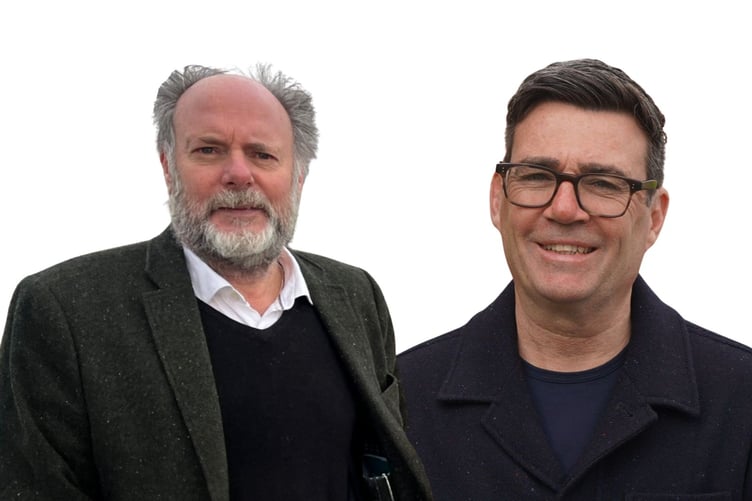
DEVON is readying a plea to the presumptive prime minister Andy Burnham to request a mayor for the county.
In a major speech in Manchester on Monday, June 29, Mr Burnham, who looks set to take control of Number 10, outlined his vision for a “re-wired Britain”, that would include the “biggest rebalance of power our country has seen”.
He clearly stated an ambition for greater devolution, meaning a desire for more decisions to be taken locally rather than from Whitehall, and Devon County Council’s leader, Councillor Julian Brazil (Liberal Democrat, Kingsbridge), has outlined plans to get his request in for a mayor as soon as he can – even before Mr Burnham is confirmed as PM.
Cllr Brazil’s hopes are that an election for a mayor could be held as early as next year.




He praised the likely PM’s mention of rural and coastal areas, and of his clear vision of devolving powers more locally and diluting the grip that Whitehall currently has over policy and decision-making.
Existing mayors tend to have greater control over the likes of transport, skills, housing and local infrastructure investment compared to local councils.
Curiously, Devon has a combined county authority, which has extra powers in relation to those policy areas, but it pursued a non-mayoral model and Plymouth didn’t join it.
Proponents of a mayor for Devon suggest it would work best if the whole county was behind a mayoralty, because then the county could tackle issues for all residents, not just some. Cllr Brazil said he thought Plymouth would be supportive of effort to secure a mayor for Devon under a possible Burnham government.
A mayor would likely sit above Devon’s councils, spearheading cross-county projects. It’s not clear yet how the relationship would work between a mayor and Devon’s local authorities, which themselves are potentially going to be radically overhauled as part of the local government reorganisation process.
Deficits are already being predicted at Devon’s newest political entity, which has quasi-mayoral responsibilities.
The levels of government funding given to the Devon and Torbay Combined County Authority (DTCCA), which was formed in February 2025, meant it was already predicting it would fall into a financial deficit in the coming years.
Officials expected deficits of £317,000 and £495,000 in the next and subsequent financial years, respectively.
Even though senior staff believed those predicted deficits could be reduced or balanced out with new income streams or cash reserves by the time the 2027/28 and 2028/29 financial years arrived, there were efforts to urge the government to provide it with more funding.
The CCA has £390,000 to fund its operations from Westminster in this financial year, but is predicting its running costs will be around £962,000.
However, thanks to the likes of interest earned on unspent cash and potential fees it could receive as part of government grant funding for specific projects, the body’s total income this financial year is predicted to be just over £1 million, meaning it can produce a balanced budget.
Comments
We've recently changed our login process. If you have an account for commenting, you will need to re-register on the login window.
This article has no comments yet. Be the first to leave a comment.