

Excavations across the Sherford development – the new town on the edge of Plymouth – have uncovered a treasure trove of archaeological gems revealing evidence of continuous human habitation stretching back thousands of years.
The latest discovery is believed to be Neolithic burial site found just metres from the well preserved Ice Age remains of mammals such as the wholly mammoth, wholly rhinoceros, wolf and hyena.
Evidence of Bronze Age, Iron Age and Roman settlements have been found over the past year.
These findings show that Sherford has long been a place where communities have lived, worked, and transformed the landscape.



.jpeg?width=209&height=140&crop=209:145,smart&quality=75)
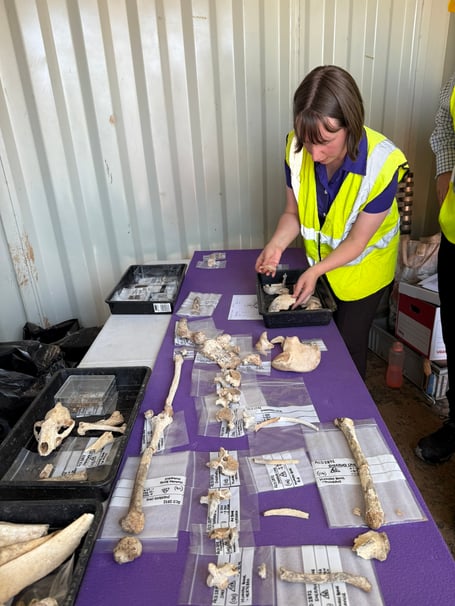
Recent investigations have taken place within Sherford Quarry where human bones, charcoal and pottery, believed to form part of a Neolithic burial site, have been found dating from around 4000 BC to 2000 BC.
Neolithic burial practices often involved burying just the bones of people in communal tombs or mounds. In this case, archaeologists believe the partial remains of two or three individuals were placed within a shallow depression in the ground. The underground structure had an hourglass-like shape, with remains initially placed in the upper chamber before gradually falling through a narrow gap into a wider cavity below, where they remained undisturbed for thousands of years.
Charcoal and pottery fragments found alongside the bones are thought to have formed part of burial rituals.
Post-excavation analysis will now take place to learn more before the remains are transferred to a local museum or repository. Once all archaeological work is complete, the area will be secured and turned into public open space for Sherford residents to enjoy.
These investigations have been undertaken by Orion Heritage for the Sherford Consortium – a partnership between award-winning national housebuilders Taylor Wimpey and Vistry Group, which includes Countryside Homes, Linden Homes, and Bovis Homes.
Sherford’s Ice Age discoveries made international headlines in 2022, drawing attention for the well-preserved remains of several rare species, all found in the same location.
Four years on, this nationally significant collection continues to provide an extraordinary window into the animals that roamed the South West during the last Ice Age.
The remains include woolly mammoth, woolly rhinoceros, and a virtually complete wolf skeleton, alongside hyena, reindeer, horse, mountain hare, and red fox. Dating from 30,000 to 60,000 years ago, the finds reveal the diversity of South West wildlife and the environment they inhabited at the time.
Carefully recorded and removed from the ground, the remains have been undergoing detailed academic analysis and conservation. The next stage is radiocarbon dating, expected to conclude later this year, after which the full archive will be transferred to The Box museum in Plymouth.
A valley running through the site has revealed Bronze Age roundhouses on both sides, likely forming small settlements made up of individual family homes. Dating from around 2000 BC to 900 BC, the Bronze Age landscape was characterised by monuments, enclosures and field systems. At Sherford, the pattern of roundhouses suggests extended family groups living and working the land.
Just south of Sherford’s Main Street, archaeologists uncovered a late Iron Age settlement, dating from 900 BC to AD 43. The settlement appears to have formed around a natural spring, with water beginning to trickle up as archaeologists excavated the area.
Further investigations towards the upper areas of Sherford revealed a substantial Roman enclosure, dating from AD 43 to AD 410.
Located close to the Roman road uncovered at Sherford in 2023, the enclosure suggests the presence of a small hamlet, forming part of an emerging Roman landscape connected to wider trade and travel networks. Within the enclosure, a raised and drier area of ground was found, that may have been an oven or corn drier.
The Sherford Consortium is funding a long-term programme of investigation to ensure that the area’s heritage is carefully recorded, preserved and understood.
Rob Bourn, managing director of Orion Heritage and lead archaeologist on the Sherford project, said: “What makes Sherford so special archaeologically is the volume and continuity of activity. We are seeing evidence of human and pre-human presence over tens of thousands of years, revealed only because the creation of the new town has allowed us to carefully peel back the layers of the past. It is incredibly rare to be able to tell such a long, connected story – from Ice Age animals, through Neolithic burial practices, to Bronze Age and Roman communities – all within one landscape.”
The ambitious Sherford development will have 5,500 new homes when it is complete. The £1 billion construction was started in 2015 and has over 1,500 homes already occupied.
Rob Baker, managing director at Taylor Wimpey Exeter, part of the Sherford Consortium, added: “We are proud that the creation of a new community at Sherford has provided such an important opportunity to better understand the area’s past. “These discoveries show that Sherford has been a place of settlement and significance throughout history, and we remain committed to ensuring that this heritage is preserved and shared for future generations.”
Comments
This article has no comments yet. Be the first to leave a comment.